 Laboratoire de Mathématiques (UMR 6205) |
 |
 Laboratoire de Mathématiques et Physique théorique (UMR 6083) |
|
Laboratoire de Mathématiques (UMR 6205) |
|
Laboratoire de Mathématiques et Physique théorique (UMR 6083) |
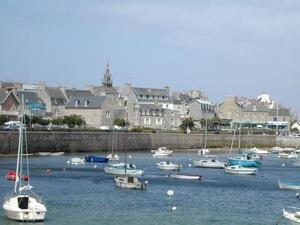
An international conference devoted to conformal geometry will be held at the Station Biologique de Roscoff (CNRS), under the auspices of the Department of Mathematics of the University of Bretagne Occidentale and the ANR " Flots et Opérateurs Géométriques ".
Conformal geometry is one of the founding themes of modern differential geometry and geometric analysis. One can cite the theorem of Riemann which states that any surface is conformal to one of constant curvature; as a consequence we have the classification of compact surfaces as quotients of a model geometry by a group of isometries. The generalization of this theorem to manifolds of arbitrary dimension: find a metric conformal to a given one with constant scalar curvature, is known as the Yamabe problem and has motivated much of the development in geometric analysis over the last twenty five years. However, the scalar curvature is not sufficiently discerning in higher dimensions to characterize the topology of manifolds and other quantities, such as Q-curvature seem to play a vital role.G. Besson (Univ. Grenoble), M. Eastwood (Univ. Adelaïde), M. Struwe (ETH Zurich)
P. Baird (Univ. Brest) , A. El Soufi (Univ. Tours), A. Fardoun (Univ. Brest) , R. Regbaoui (Univ. Brest)
A. Cap (Univ. Vienne)
G. Carron (Univ. Nantes)
J. Choe (KIAS, Korea)
B. Colbois (Univ. Neuchatel)
Z. Djadli (Univ. Grenoble)
A. Gastel (Friedrich-Alexander-Universität)
R. Gover (Univ. Auckland)
R. Graham (Univ. Washington)
M. Gursky (Univ. Notre Dame)
F. Hélein (Univ. Paris VII)
K. Hirachi (Univ. Tokyo)
D. Knopf (Univ. Texas, Austin)
C. LeBrun (Univ. Stony Brook)
A. Malchiodi (SISSA, Trieste)
R. Mazzeo (Stanford Univ. )
N. Nadirashvili (Univ. Marseille)
S. Nishikawa (Tohoku Univ. )
F. Pacard (Univ. Paris XII)
F. Pedit (Univ. Tübingen)
T. Rivière (ETH Zurich )
F. Robert (Univ. Nice)
U. Simon (Technische Univ. , Berlin)
H. Urakawa (Tohoku Univ. )
J. C. Wood (Univ. Leeds)
S. Yamada (Tohoku Univ. )
|
|
|
|
|
|
 |

|
 |
